
The ultimate guide to fittonia nerve plant care and low light
What You Need to Know About Fittonia Nerve Plant Care
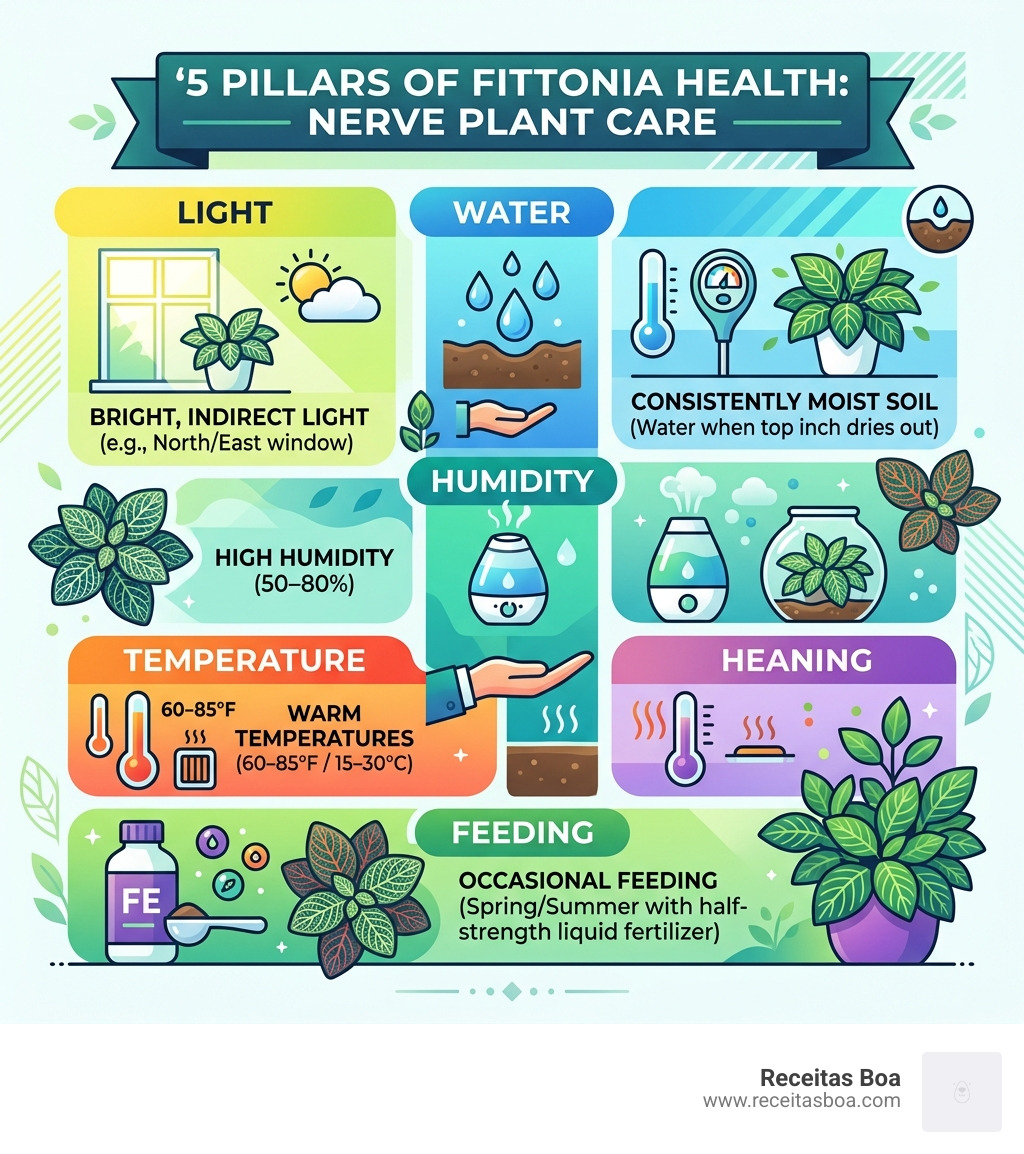
Fittonia nerve plant care comes down to five core things: the right indirect light, consistent moisture, high humidity, warm temperatures, and occasional feeding.
Quick care snapshot:
| Care Factor | What Fittonia Needs |
|---|---|
| Light | Bright, indirect light (north or east window) |
| Water | Keep soil moist; water when top inch dries out |
| Humidity | 50–80% (bathroom, terrarium, or humidifier) |
| Temperature | 60–85°F (15–30°C), optimal around 70°F (21°C) |
| Fertilizer | Balanced liquid feed at half strength, spring and summer |
| Soil | Well-draining, peat-based mix, pH 6.0–7.0 |
| Repotting | Every 1–3 years |
The Fittonia (Fittonia albivenis) is a low-growing tropical evergreen from the rainforests of South America, mostly Peru. It stays compact — rarely taller than 3 to 8 inches — and spreads up to 18 inches wide. Its real appeal is its leaves: deep green with intricate veins of white, pink, or red that look almost like a hand-drawn map.
It goes by many names — nerve plant, mosaic plant, painted net leaf — and it earns every one of them.
Here’s the thing most people don’t know going in: Fittonia will literally faint when it’s thirsty. The stems collapse, the leaves droop, and it looks completely dead. But water it promptly, and it bounces back within an hour or two. It’s one of the few houseplants that actually tells you what it needs.
That dramatic communication style is part of what makes it manageable — even in a dim apartment. You just have to learn to speak its language.
Mastering Fittonia Nerve Plant Care: Light and Environment
When we talk about fittonia nerve plant care, we have to start with where these beauties come from. Imagine the floor of a South American rainforest. It’s warm, it’s incredibly humid, and the light is filtered through layers of giant tree canopies. That is the environment we are trying to recreate in our homes.
Because they are understory plants, they aren’t built for the harsh, direct sun that might suit a cactus. Instead, they thrive in a “Goldilocks” zone of light and temperature. Research shows that Fittonias are happiest when temperatures stay between 60-85°F (15-30°C). If the temperature dips below 55°F, the plant will start to protest, often by dropping leaves or simply stopping all growth.
Humidity is perhaps the most critical environmental factor. In their native habitat, humidity rarely drops below 70%. In our modern homes, especially during winter when the heater is running, humidity can plummet to 10-20%. This is why Fittonias are often labeled as “finicky.” However, with a few simple tricks, we can make them feel right at home.
Optimizing Light for Fittonia Nerve Plant Care
One of the biggest questions we get at Receitas Boa is whether these plants can handle low light. The answer is a resounding yes, but there’s a nuance to it.
- North-Facing Windows: These are the holy grail for fittonia nerve plant care. They provide consistent, soft light throughout the day without the risk of leaf scorch.
- Dappled Sunlight: If you have an east-facing window, placing your Fittonia a few feet back so it gets gentle morning sun is perfect.
- Fluorescent and LED Grow Lights: Fittonias adapt beautifully to office environments or windowless rooms if you provide artificial light. We recommend keeping them under a grow light for about 8-12 hours a day if natural light isn’t an option.
How do you know if the light is wrong? If the leaves look bleached or develop crispy brown patches, it’s getting too much direct sun (leaf scorch). Conversely, if the plant becomes “leggy”—meaning the stems grow long and spindly with huge gaps between the leaves—it’s reaching for more light. If the vibrant pink or white veins start to fade into a dull green, that’s another sign your plant needs a brighter (but still indirect) spot.

Maintaining Tropical Humidity and Temperature
If you want your Fittonia to look like it just stepped out of a Peruvian jungle, you have to tackle the humidity. We aim for a range between 50% and 80%. Here are our favorite ways to achieve this:
- The Bathroom Strategy: If your bathroom has a window, put your Fittonia there. The steam from your daily shower creates a natural microclimate that these plants adore.
- Pebble Trays: This is a classic indoor gardening hack. Fill a shallow tray with pebbles and water, then set the pot on top (making sure the bottom of the pot doesn’t actually touch the water). As the water evaporates, it creates a humid “bubble” around the foliage.
- Grouping Plants: Plants “breathe” out moisture through a process called transpiration. By grouping your Fittonia with other moisture-loving plants, they help keep each other humid.
- Room Humidifiers: If you have a large collection of tropicals, a small humidifier is the most effective long-term solution.
A quick warning on temperature: Keep your Fittonia away from AC vents and heating radiators. Sudden drafts are a leading cause of leaf drop. We want consistency; an optimal temperature of around 70°F (21°C) will keep the plant in a steady state of growth.
Watering and Feeding Your Nerve Plant
Watering is where most people get tripped up with fittonia nerve plant care. Because this plant is so dramatic, it’s easy to panic.
The goal is to keep the soil consistently moist, like a wrung-out sponge. You never want the soil to be “muddy” or “soggy,” as this leads to root rot, but you also don’t want it to turn into a dry brick. We recommend checking the soil every couple of days. If the top quarter-inch feels dry, it’s time for a drink.
Always use room-temperature water. Frigid water straight from the tap can shock the delicate tropical roots, leading to—you guessed it—more drooping.
Overwatering vs. Underwatering: How to Tell the Difference
It can be confusing because both overwatered and underwatered plants can look “sad.” Use this table to help you diagnose the issue:
| Symptom | Likely Cause | Fix |
|---|---|---|
| Limp, wilted leaves + Dry soil | Underwatering (The “Faint”) | Water immediately; it should perk up in 1-2 hours. |
| Yellowing leaves + Soggy soil | Overwatering | Stop watering; check for root rot; improve drainage. |
| Soggy, mushy stems | Advanced Overwatering/Rot | Repot into fresh, dry soil; cut away black/mushy roots. |
| Crispy, brown leaf edges | Low Humidity or Underwatering | Increase misting or use a pebble tray. |
Essential Nutrients for Fittonia Nerve Plant Care
Fittonias aren’t heavy feeders, but they do appreciate a little boost during the growing season (spring and summer). We recommend using a balanced 5-5-5 liquid fertilizer.
The Golden Rule of Fertilizing Fittonia: Always dilute your fertilizer to half the strength recommended on the bottle. These plants have sensitive roots, and full-strength fertilizer can cause salt buildup, which burns the leaf tips. Feed your plant every 4-6 weeks from March through September. In the winter, the plant’s metabolism slows down, so we skip the fertilizer entirely to avoid stressing it.
Choosing the Best Soil and Pot
The right foundation makes fittonia nerve plant care much easier. You need a soil that holds onto moisture but lets excess water escape quickly.
- Soil Mix: A peat-based or coco coir-based potting mix is ideal. We like to add a handful of perlite or orchid bark to the mix to ensure the roots can breathe.
- pH Level: Fittonias prefer a slightly acidic to neutral soil pH, ideally between 6.0 and 6.5.
- The Pot: Because Fittonias have very shallow root systems, they actually prefer wide, shallow pots rather than deep ones. Most importantly, your pot must have drainage holes. Without them, water pools at the bottom, and your plant will succumb to root rot within weeks.
Advanced Maintenance: Pruning, Repotting, and Propagation
To keep your Fittonia looking like a lush carpet rather than a collection of long, naked sticks, you need to be proactive with maintenance.
How to Make Your Fittonia Bushy
If left to its own devices, a Fittonia can become “leggy.” To prevent this, we practice “pinching.” Simply use your fingernails or a clean pair of scissors to snip off the top 1-2 inches of each stem. Make the cut just above a leaf node (the spot where leaves grow out of the stem). This tells the plant to stop growing up and start growing out, leading to a much fuller, bushier appearance.
Repotting
Fittonias are slow growers, so you’ll likely only need to repot every 1–3 years. The best time to do this is in early spring before the “growth spurt” begins. If you see roots poking out of the drainage holes or the water runs straight through the pot without soaking in, it’s time for a bigger home. Choose a pot that is only 1-2 inches wider than the current one.
Propagation: Sharing the Love
Propagating a Fittonia is incredibly easy and a great way to fill out a “hollow” looking plant.
- Stem-Tip Cuttings: Snip a 4-6 inch stem that has at least 2-3 leaf nodes.
- Water Method: Place the cutting in a glass of room-temperature water. Change the water every few days. You should see roots appearing within 2-3 weeks.
- Soil Method: Dip the end in a little rooting hormone (auxin) and stick it directly into moist potting soil. Cover the pot with a plastic bag to create a mini-greenhouse effect.
- Division: When repotting, you can gently pull the root ball apart into two or three smaller sections and pot them individually.
Troubleshooting Common Fittonia Problems
Even with the best fittonia nerve plant care, issues can pop up. The key is to catch them early.
Common Pests
Fittonias can attract a few uninvited guests:
- Aphids & Mealybugs: These sap-sucking insects love the tender new growth. If you see tiny green bugs or white, cottony tufts, treat the plant with neem oil or insecticidal soap.
- Fungus Gnats: These are the tiny black flies that hover around the soil. They thrive in overly wet soil. Letting the top inch of soil dry out usually solves the problem.
- Spider Mites: If you see tiny webs between the leaves, your humidity is too low. Blast the plant with water to knock them off and increase the humidity immediately.
Environmental Stress
- Yellowing Leaves: This is almost always a sign of overwatering. Check that the drainage holes aren’t blocked.
- Leaf Drop: This is usually caused by a cold draft or a sudden change in temperature. Move the plant to a more protected “cozy” corner.
- Brown, Shriveled Leaves: This is a cry for help regarding humidity or a sign of too much direct sunlight.
Disease
- Mosaic Virus: If you see strange, mottled yellow patterns that don’t look like the normal veins, it could be a virus. Unfortunately, there is no cure for mosaic virus; you should remove the infected plant to protect your other greenery.
- Root Rot: If the base of the plant turns black and mushy, it’s root rot. You can try to save it by cutting away the rot and repotting in fresh, dry soil, but it’s often a tough battle.
Frequently Asked Questions about Fittonia
Is the Fittonia nerve plant pet-friendly?
Yes! One of the best things about fittonia nerve plant care is that it is completely non-toxic. According to the ASPCA, Fittonias are safe for both cats and dogs. They are also safe for humans, making them a perfect choice for households with curious toddlers or nibbling pets.
How do I make my Fittonia bushier?
The secret is regular pruning. By pinching off the growing tips (the top 1-2 inches), you force the plant to activate the dormant buds lower down the stem. This results in lateral branching. Instead of one long stem, you get two or three, which fills in the gaps and creates that lush, carpet-like look.
Why is my Fittonia dropping leaves?
Leaf drop is the plant’s way of saying “I’m stressed!” The most common culprits are cold drafts (like being too close to a window in winter), sudden temperature fluctuations, or the soil being allowed to dry out completely. Check your moisture levels and ensure the plant is in a stable, warm spot.
Conclusion
At Receitas Boa, we believe that everyone should be able to enjoy the beauty of rare and exotic plants, regardless of how much light their home gets. Fittonia nerve plant care might seem intimidating at first because of the plant’s dramatic “fainting” spells, but once you understand its need for humidity and indirect light, it becomes a rewarding and expressive companion.
As we move through April 2026, the trend in indoor gardening is all about creating “wellness spaces”—miniature jungles that clean our air and soothe our minds. The Fittonia, with its air-purifying qualities and stunning patterns, is the perfect candidate for your desktop, bathroom, or terrarium.
Whether you are a seasoned “plant parent” or just starting your journey with a “black thumb,” remember that consistency is key. Keep it warm, keep it humid, and listen to what those beautiful leaves are telling you.
